Essential safety information for proper sling usage and load calculations.

Eyes should fit freely on the hook.
Snug fits greatly increase eye strain.

Tight chokes greatly increase sling stress.
Full wrap before choke gives no-slip lifting.
As the sling-to-load angle decreases, so does the rated capacity of a sling.
Use this chart for all type slings: rope, chain or synthetic web.
Sling-To-Load Angle is always the angle between the sling leg and the horizontal surface.
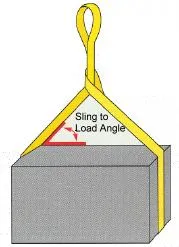
| Sling-To-Load Angle | Lifting Efficiency | Capacity @ 90° | Actual Capacity |
|---|---|---|---|
| 90° | 100.0% | 1000 lbs. | 1000 lbs. |
| 75° | 96.6% | 1000 lbs. | 966 lbs. |
| 60° | 86.6% | 1000 lbs. | 866 lbs. |
| 45° | 70.7% | 1000 lbs. | 707 lbs. |
| 30° | 50.0% | 1000 lbs. | 500 lbs. |
| 15° | 25.8% | 1000 lbs. | 258 lbs. |
| 5° | 8.7% | 1000 lbs. | 87 lbs. |
Warning
Work load limits will be reduced when less than 90° from horizontal. Angles of less than 30° are not to be used.
Inspect before use. Additional requirements and safe operating practices are outlined in current OSHA, Federal Register Part 29, 1910.184 and ASME B30.9 c-2000.
Death or injury can occur from improper use or maintenance!
At 30° angle, your sling only provides 50% of its rated capacity
Always check for damage, wear, or defects before each lift.
Never exceed the rated capacity for your sling configuration.
Never use angles less than 30° from horizontal.
Use corner protectors when lifting loads with sharp edges.


 Safety Netting
  Barrier Netting
  Loading Dock Safety Nets
  Facility & Warehouse Safety
  Construction Safety Catalog
  Debris Netting Panels
  Fall Safety Netting
  Steel Netting
  Kevlar Reinforced Netting
  Conveyor Netting
  Drone Safety Netting
  Spectator Safety Products
  Transportation Safety Netting
  Plastic Fence
  Cargo Nets
  1" Webbing Cargo Net
  2" Webbing Cargo Net
  Custom Cargo Netting
  Cargo Netting Roll
  Military Grade Cargo Lifting Net
  Decorative Rope Cargo Net
  Truck Cargo Net
  Truck Cargo Net Kit
  Rope Cargo Net
  Steel Cargo Net
  Kevlar Reinforced Cargo Net
  Jumbo Lifting Nets
  Warehouse Cart Netting
  Pallet Rack Netting
  Debris Net Rolls
  Loading Dock Solutions
  Wall Mounted Loading Dock Nets
  Above-Ground Loading Dock Safety Nets
  In Ground Loading Dock Nets
  Existing Bollard Safety Nets™
  Construction Netting and Mesh
  Debris Netting Panels
  Fall Safety Netting
  Debris Netting Rolls
  Hatch Safety Netting
  Safety Barrier Netting
  Warehouse Safety Netting
  Hatch Netting
  Rack Safety Netting
  Loading Dock Solutions
  Military Netting
  Plastic Netting
  All Purpose Nets
  Barrier Netting
  Custom Barrier Netting
  EZ Barrier
  Knotless & Knotted Barrier Netting
  Sports Barrier Netting
  Warehouse & Dock Safety Barriers
  Pallet Rack Barrier Netting
  Sports Netting
  Custom Sports Netting
  Golf Netting, Barriers & Cages
  Baseball Netting & Cages
  Spectator Safety Products
  Camouflage Nets
  Drone Netting
  Gym Divider Curtains
  Lacrosse Backstops
  Agricultural & Pest Control Netting
  Shade Cloth
  Trellis Netting
  Crop Protection & Blueberry Netting
  Bird Netting
  Pond Netting
  Pest Control
  Poultry Netting
  Shade Cloth
  Square / Rectangular Shade Cloth
  Triangular Shade Cloth
  Metal Netting
  Steel Cable Netting
  Decorative Steel Netting
  Steel Chain Netting
  Conveyor Netting
  Light Duty Conveyor Netting
  Heavy Duty Conveyor Netting
  Heavy Duty Conveyor Netting w/ Debris Liner
  Plastic Fence Netting
  Multi-Use Plastic Fence
  Safety Barrier Fence
  Containment Netting
  Deer Fence
  Plastic Elk Fence
  Plastic Agricultural Netting
  Plastic Pallet Rack Netting
  Plastic Bird Netting
  Plastic Poultry Netting
  Plastic Snow Fence